The complete record: the idea, the one rule everything bends around, the casting system, every failure worth knowing about, and the seven rewrites of the scene that kept breaking.
3:29finished film
9generations
43,610characters of prompt
47shots
4reference images
0cameras
00
It started as a sentence someone says on a dock.
The film began with a situation rather than a plot: three friends miss their cruise ship by ten minutes on a Greek island. That is an ordinary travel anxiety. Everyone who has ever been on a boat has felt the edge of it. It needs no explaining, no exposition and no world-building, which matters enormously when your entire budget for setup is thirty seconds.
The second half arrived with the first: the kind woman on the dock who offers to drive them to the next port is not a passenger. That is the whole film. Everything after it is execution.
What made it worth making is that the premise is already structured like a thriller. The audience works out what is happening several minutes before the characters do, and there is nothing they can do about it. Dread is cheaper than shock and it lasts longer.
A holiday film and a horror film are shot identically. Only one of them tells you which it is.
the production note that set the visual approach
The decision that followed from that: nothing about the photography changes when the story turns. Same golden hour, same clean wides, same lenses, from the first frame to the last. A kidnapping at dusk is a genre. The same thing at seven in the evening, shot like a travel film, is a nightmare.
01
One rule, written before anything else: she is kind.
Before a single prompt was written we fixed one rule, and everything else bends around it.
Elena is not creepy. She is kind. She is kind in the last frame too.
The reason is structural. If she reads as sinister when she arrives at the dock, then three intelligent adult women get into her van anyway, and the audience stops believing in them. You lose the characters to serve a mood, and the film dies right there.
So she is warm. She is out of breath when she arrives because she hurried. She apologises for the state of the van. She doubles her words the way people do when they are being reassuring — "It is okay. It is okay." She never hurries, never raises her voice, and never once in the film looks at the camera in a way that tells you anything.
This is also written into the prompt as a hard constraint, because the model will otherwise reach for horror shorthand on its own: She is never lit or framed as a villain.
The pay-off is the last shot. Three men are taking her passengers into a house. She is folding her tote. She holds the gate open and smiles at the one who is not fighting, exactly the way she has smiled all day. She is the only person in the frame behaving normally, and that is the most frightening thing in the film.
02
Thirty seconds, 4,990 characters, no memory.
Seedance 2.5 generates thirty seconds at a time from at most 4,990 characters of text, and it remembers nothing between runs. Those three facts determined the entire shape of the production, so it is worth being precise about what each one costs.
Thirty seconds is the scene length
Not a limit you work around — a unit you write to. Each block has to open, do one thing, and close, because there is no guarantee the next block looks like this one. The film is seven blocks plus two behind-the-scenes pieces. Every block was written to hold up on its own.
4,990 characters is roughly 800 words
That sounds generous until you write a shot list, a full script, sound design and a consistency section into it. Most of the prompts land within fifty characters of the ceiling. The discipline it forces is useful: every sentence has to earn its place, and when you need to add something you have to decide what to delete. Setup is always what goes. Action never is.
No memory means no chaining
The model offers video extension — feed it the last block and continue. We tried it and abandoned it. Faces hold well within a single generation and degrade across a chain, so by the third link the cast are strangers. Every block in this film is a standalone generation, and continuity is carried in text: the same colours, the same reference images, the same lens language, restated in full every time.
The cost is repetition — roughly a third of every prompt is scaffolding that appears in all of them. The benefit is that any block can be re-rolled at any time without inheriting a drifted face from the block before it. On a film that was re-generated as many times as this one, that trade was not close.
Block
Runtime
Prompt
Shots
00 · Opening titles
~20s
4,721
5
01 · Cold open
~10s
3,072
3
02 · Off the ship
30s
4,864
7
03 · The island
30s
4,939
9
04 · The miss
30s
4,806
5
05 · The house
30s
8,793
6
06 · Teaser
~12s
4,017
3
BTS · On set
30s
4,194
5
BTS · Interviews
30s
4,204
4
The house runs to 8,793 characters because that single generation was given a larger budget. Every other prompt is written to the 4,990 ceiling.
03
Three women the same age is the hardest job you can give the model.
Three women of similar age, similar build, in the same light, in almost every shot. There is no harder consistency problem to hand a video model, and the official guidance says so plainly: too many similar references and you get character confusion or duplication.
The system that fixed it has three parts.
One image each, bound by position
Seedance binds references by upload order, not filename. @Image3 means the third file you uploaded on this generation — nothing written on the image itself ever reaches the model. So the order is fixed for the life of the production and never changes:
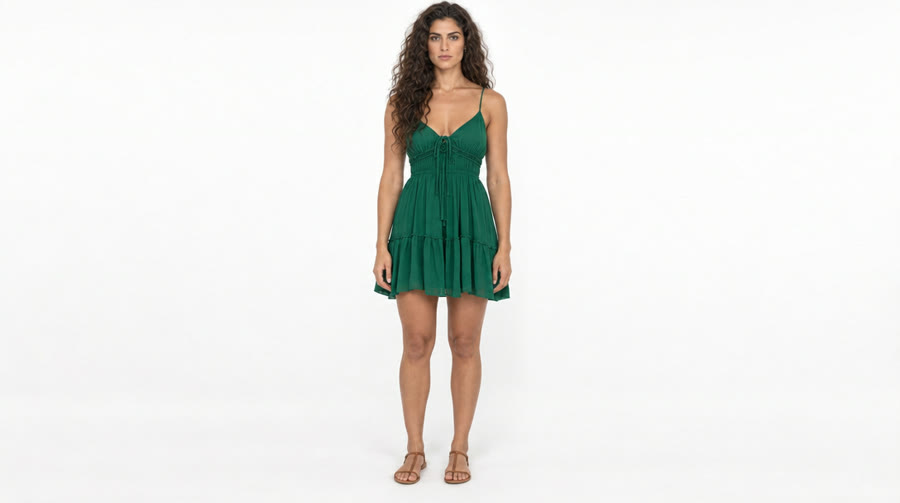
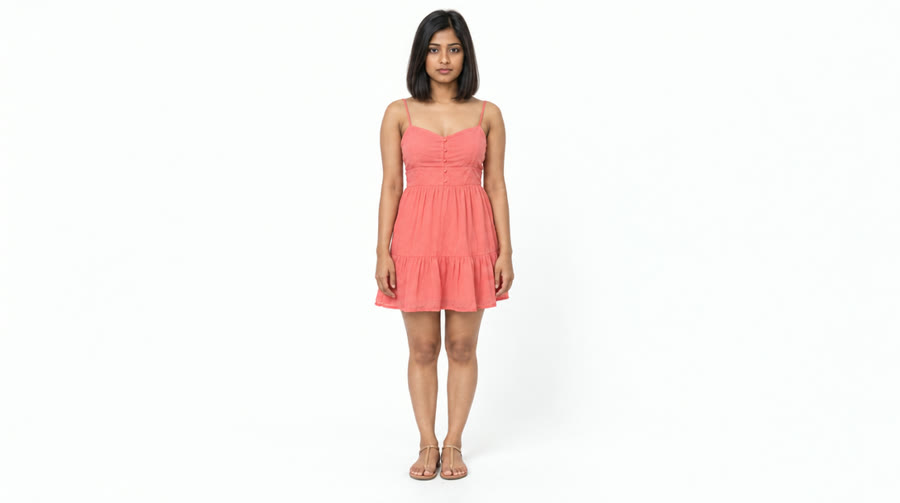
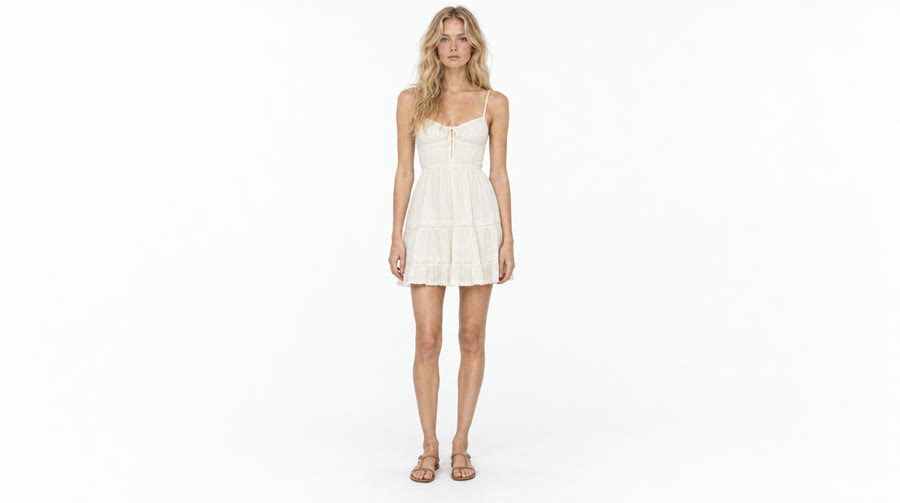
Asset Bindings: Nadia is @Image1, Priya is @Image2, Cass is @Image3, Elena is @Image4.
Each image defines exactly one person: her face, hair, build and clothing.
There are exactly four women in this video. Never duplicate, merge or blend them.
Elena enters in block 04. Because she is bound at slot four rather than inserted in the middle, nothing before her shifts when she arrives.
One colour each, never swapped
Emerald, coral, cream. The reason is not styling. At a hundred metres, in motion blur, in a compressed upload, a face is a smudge and a colour is still a colour. Colour is the only identity signal that survives the whole range of shot sizes in this film, and it lets the audience track three people in a wide shot without a single close-up to help them.
The tag goes where the action is
Not in a list at the top. In the sentence, at the moment the person does something: "the second man takes Priya @Image2 by both upper arms". A prompt that names its references only once, far from the action, is handing the model four unlabelled images and a description of three similar women, and asking it to guess.
@Image1 · Nadia · emerald@Image2 · Priya · coral@Image3 · Cass · cream@Image4 · Elena · straw hat
There is no reference image for the ship, the island or the house. Locations tolerate drift; people do not. Spending reference slots on scenery is how you run out of slots for faces.
04
What a prompt actually looks like when it works.
Every prompt in the film is built in the same order. Front-loaded tokens carry more weight, so the first sentence is a plain-English summary of the whole block — the model reads it as the thesis and everything after it as detail.
<one-sentence summary of the entire block>Visual Style:format, sensor, lenses, grain, grade — identical in every blockAsset Bindings:who is which @Image, and the headcount[Subject settings]colours, wardrobe, behaviour, anatomy rules, location[Optics and light]lens per shot size, sun direction, shadow behaviour[Shot list]N shots with timecodes, camera in brackets, first frame named
Shot 3 (8-15s): [Close handheld, 35mm, chest height] ...
Dialogue (Nadia, flat, quiet): "Whose house is this."
[Spoken text]language lock, who speaks, who does not[Audio]timed sound design, and the two supported negations[Consistency]what must not drift, stated positively
Four things in that skeleton do most of the work:
Prose, not keyword soup
The model parses sentences. "He walks her backward across the yard, both her feet on the ground" produces a shot. "kidnapping, dragging, gravel, backward" produces a mess.
Camera in square brackets, per shot
Shot size, movement, lens and height. This is the single highest-leverage line in any shot — more than any adjective you can write about mood.
A named first frame
Seedance composes the opening frame and drifts from it. Saying "First frame: Cass's face filling the left of frame" is how you control the other four seconds.
Timecodes that sum exactly
0-5, 5-8, 8-15, 15-20, 20-26, 26-30. Gaps and overlaps both produce pacing the model invents to fill.
05
Nine sentences that failed, and what replaced them.
This is the useful part. Every one of these was found by watching a take, not by reading the prompt back. None of them were obvious in advance, and several are the opposite of what a writer's instinct suggests.
Visual negation does not exist
symptom — the model drew a face. Twice.
wrote
Her face is never clearly shown.
shipped
[Medium over-the-shoulder, the camera standing directly behind the young woman] — the camera sees her shoulders, her backpack and the back of her head.
Seedance supports negative control over subtitles and audio only. Everything else is read as tokens. "Never show her face" puts the word face in the prompt and nothing else. The fix is never to ask for an absence — it is to give the camera a physical position from which the thing is not visible. One is a wish; the other is an instruction.
The same bug, wearing a different hat
symptom — a woman floated across the yard with nothing holding her
wrote
A dark out-of-focus shape with no face and no detail lifts her clear off her feet.
now
Three men in dark navy work clothes... Their faces are sharp, in focus and plainly visible. They are solid, ordinary men with real weight and real hands.
We wanted the men anonymous and asked for a blur. A blur has no hands. The model rendered exactly what was described — an indistinct shape — and then had nothing to attach a grip to, so the person it was supposed to be carrying simply moved through the air. Anonymity had to come from framing, and then eventually we abandoned it entirely: three ordinary men with visible, bored faces are far more frightening than a shadow.
Never lift anyone
symptom — an actress's legs bent backwards
wrote
Priya is caught at the waist and lifted off the gravel.
shipped
He walks her backward, both her feet on the ground the whole way, her heels ploughing two long parallel lines through the gravel.
A lift-and-twist gives the model no stable skeleton: the hips leave the ground, the knees have nothing to resolve against, and it invents a joint. Every contact in the finished film is horizontal — people are pulled, held and walked, never lifted, swung or carried — and the rule is stated explicitly in the prompt rather than left implied.
An accent tag is an instruction to speak that language
symptom — invented Greek
wrote
Warm Greek-accented English, spoken quickly and kindly.
shipped
Every word spoken is in English and only English, in natural British accents. No foreign language or invented words.
The model heard Greek and obliged. Elena's warmth had to come from what she says and how she says it — doubling her words, never raising her voice — rather than from an accent label.
We wrote an instruction not to speak
symptom — the film was silent
wrote
The three are heard talking, but it is indistinct chatter with no intelligible words.
shipped
Dialogue (Nadia, flat, quiet): "Whose house is this."
That sentence reads to a human as atmosphere and to the model as a direction: produce no intelligible speech. It did exactly that. The replacement is thirty-six written lines across the film — an actual script. The single best line in it is four words long and has no question mark.
Say the words out loud before you write them
symptom — a line that meant two things
wrote
Dialogue (Elena): "You too? Oh, no."
shipped
Dialogue (Elena): "You missed it as well? Oh, no."
Spoken aloud, you too is you two — said to three women. The rewrite also does more work: it states her lie out loud, which is better writing independent of the bug.
The model renders every noun you hand it
symptom — a donkey wandered into a chase scene
wrote
Old stone steps shared with donkeys that take the width of the path.
shipped
...tourists climbing up against them, forcing them into single file along the wall.
Historically accurate for the location, and completely wrong for the scene: a donkey in a chase reads as comedy. Colour and scenery details are rendered at whatever prominence the model feels like, so anything in the frame during a tense beat has to be chosen for what it does to the tension.
A safety line that did the opposite
symptom — none, which is the point
wrote
Nobody is visibly injured and there is no blood.
shipped
deleted entirely
Negation is not parsed. That sentence put injured and blood into the prompt and achieved nothing else. If you do not want something in the frame, the answer is to not write the word.
Resistance that fails is what makes it read as force
symptom — the abduction looked like a hug
wrote
A man's arm comes around her from behind and he walks her toward the house.
shipped
She gets one arm loose and swings it back at his head; he catches the wrist and folds it back down across her chest. Her feet skid on the gravel and find no purchase.
A still frame of a hold and a still frame of an embrace are nearly identical. What separates them is an escape that almost works and is then shut down. Add pinned arms, a failed swing, feet that cannot get traction and a body going dead weight, and the same blocking reads unambiguously as capture. This was the last bug fixed and the one that took longest to see.
06
Directing a film you cannot point a camera at.
With no camera, no crew and no location, everything a director normally does on the day has to be done in advance, in prose. Three levers do nearly all of it.
Lens
Named per shot size and kept consistent across the film. 24mm for the landscape wides with a low horizon, 35mm for mediums, 35–50mm handheld at chest height for anything close. A stated focal length is the difference between a shot and a description of a shot.
Light direction
Not "golden hour" — where the sun is. In the final block the sun is low and behind the house, so the yard is blazing and the doorway is a hard black rectangle. Nobody has to be told it is bad to be walked into it.
Camera behaviour as a story beat
The final block is locked off for eight seconds and handheld and close for the remaining twenty-two, moving with whoever is being taken. The change in the camera is the change in the film, and it costs one sentence.
Silence
The most effective instruction in the whole production is the absence of sound. Six seconds of cicadas and ticking metal before the last block detonates, and a hard cut to nothing on the final latch. Terror needs quiet in front of it.
The sun as a clock
There is no clock in the film and no title card telling you the time. The only way the audience knows a whole day has gone is where the shadows are. Block 03 puts the sun in three positions inside thirty seconds — overhead with hard short shadows, long and gold, then touching the horizon — with the ship at anchor under all three. Then she looks down at her phone, looks up, and the anchorage is empty.
The music stops dead, mid-bar, at 0:57. Nothing is said. The water does it.
Sound designed on a timeline
The audio block is written with timecodes exactly like the shot list, because pacing is mostly a sound problem. From the final prompt:
Gravel under tyres, then the engine switching off and cooling. Five seconds
of near silence: cicadas in dry grass, a loose shutter knocking, ticking
metal, the gate settling into its latch. From 8 seconds it breaks at once
and does not let up for twenty-two seconds: continuous raw screaming,
running feet on gravel, the gate hauled hard against its lock, heavy boots
grinding through gravel, heels and then knees ploughing it, a phone hitting
stones, hard ragged breathing close to the microphone. Cicadas continue
underneath all of it. Everything cuts dead on the latch.
The cicadas continuing underneath is the detail that matters. The world does not react. It is a nice evening.
07
The scene that broke seven times.
One block took seven attempts. It is the climax of the film, it contains every hard problem in the production at once — four people, sustained physical contact, continuous screaming, a moderation-sensitive subject and a hard character ceiling — and the full record of it is more instructive than any amount of theory.
v1
—
The faceless figure
A dark out-of-focus shape with no face lifts her off her feet and carries her inside. Written for anonymity and menace.
A person flew across the yard with nothing holding her.
v2
—
Solid men, still lifting
Real bodies instead of a blur, faces turned away, but the blocking still had someone caught at the waist and lifted.
An actress's legs bent backwards.
v3
—
Blocked
The rewrite that finally described the abduction plainly came back as InputTextRisk (code 2038).
Nothing generated at all.
v4
—
Off-screen
The whole thing moved outside the frame: drag marks in gravel, a dropped phone, an empty yard. Clean, and genuinely effective.
Generated — but the film now had no climax.
v5
4,988
Back on screen, walked not lifted
Restored the abduction with an explicit anatomy rule: both feet on the ground, knees and elbows bending the right way, nobody lifted or carried.
Generated, anatomy intact — and it read like a scuffle at forty feet.
v6
4,989
Force direction
Arms pinned, a failed escape, dead weight dropped onto both knees, wrists crossed behind the back, the camera handheld and inside it. Also the arithmetic fix: the taking got twenty-two seconds instead of twelve by cutting the van ride out of the block entirely.
Reads as an abduction.
v7
8,793
The full version
With a larger character budget: lens per shot size, sun direction, a named first frame on every shot, performance notes for all seven people in the yard, and one story fix — in the opening wide, behind the van, the iron gate swings closed on its own weight and nobody looks at it. When she hits that gate ninety seconds later, you already watched it shut.
The version in the film.
The two lessons
Screen time is a prompt parameter. Twelve seconds split between three people is four seconds each, and four seconds is not enough for a model to show a person being taken — you get milling about. The same words with twenty-two seconds and one person per beat produce a scene. Before rewriting a sentence, check the arithmetic.
Intensity is camera distance, not vocabulary. Not one violent adjective was added between v5 and v6. What changed was the camera moving from a locked-off wide into a handheld close, and the contact points being named exactly. Adjectives are the least effective tool available, and they are also the ones most likely to get a prompt blocked.
08
Everything legible was added afterwards.
Legible text is the least reliable thing a video model produces, and one misspelled sign undoes the whole illusion. So everything readable in the film was either generated deliberately blank or thrown far out of focus, and added afterwards.
Generated blank
The gangway sign on its easel. The keycards. Every phone screen. The blue card in Elena's tote is described as a plain pale blue card and nothing else — the audience needs to register that it exists, not read it.
Composited after
All four opening title cards, every credit, and the episode-two end tag. The one exception is the title sequence itself, which was generated with text on purpose — short capitalised words, held still, spelled out twice in the prompt. It came back clean.
The cold open and the teaser stinger were both written last, once the middle of the film held together. That ordering matters: a cold open is a promise about the film you are about to watch, and you cannot make it accurately until the film exists.
The cut runs 3 minutes 29 seconds including credits and the cast interviews that play after the end card.
09
The music stops at 0:57 and never comes back.
The score is instrumental throughout — no lyrics anywhere — and it is used far less than you would expect. Music runs under the holiday and it stops, mid-bar, at 0:57, the moment she looks up and the anchorage is empty.
From that point to the end of the film there is no melody at all. A single held low note at the house, then silence, then screaming, then a latch.
Scoring the last ninety seconds would have told the audience how to feel. Not scoring it makes them decide.
The prompts for the two cues are on the main page. Both are written the way the shot lists are: a tempo, a key, an instrument list, and a timecode at which the thing stops existing.
10
The whole film, counted.
Finished runtime
3:29
Generated blocks
9
Prompts written
9
Total prompt text
43,610 characters
Shots described
47
Lines of dialogue
36
Reference images
4
Cameras, crew, locations, actors
0
Two of those numbers are worth sitting with. Four reference images carried four people across nine separate generations with no chaining and no shared memory between them. And 43,610 characters — about seven thousand words, roughly a long magazine feature — is the entire production: the script, the shot lists, the casting, the sound design and the grade.
11
What we would do differently.
Four things, in order of how much they would change.
Write the anatomy rule first, not fifth
Both feet on the ground or both knees on the ground, knees and elbows bending in the correct direction, nobody lifted, swung, thrown or carried. That paragraph costs about two hundred characters and would have saved two complete regenerations. It belongs in the template, in every prompt with physical contact, before anything else is written.
Read every prompt back hunting only for negations
A dedicated pass that looks for nothing except never, no, without and not applied to something visual. Every instance is either a bug or a wasted sentence. This single pass would have caught three of the nine failures above.
Budget seconds per character before writing
Decide how long each person's moment gets, then write to it. The scene that broke seven times was fundamentally a scheduling error for its first five versions, not a writing one.
Give recurring people a reference plate, even minor ones
The three men have no reference image, so they are described in prose and may drift slightly between shots. It held here because they appear for twenty seconds. If any of them returns in episode two, that is a plate that should have existed from the start.
Made with Pixio
Everything on this page is a text file you can copy.
The nine prompts are on the main page, unedited and complete. Generate on Seedance 2.5 in Pixio and cut it yourself.